Growing up displaced in Gaza
6 March 2026Although Farah’s daily life is marked by struggle, she has hope for her future.
For 11‑year‑old Farah, life in Gaza is defined by displacement, hunger, and the daily search for essentials like water and food. Her family has spent the past year and a half living in a single worn‑out tent on the street. Despite losing two years of schooling, Farah returned to class a week ago, determined to learn again, even without books or notebooks.
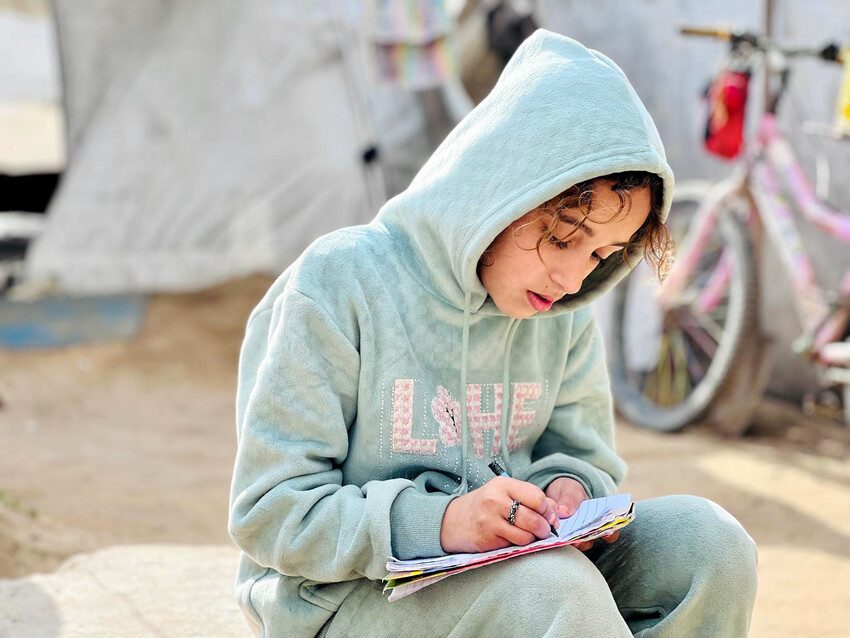
Farah shares the tent, no larger than a small room, with 11 members of her family. Made from thin, weathered fabric, it offers little protection from Gaza’s harsh seasons. “I don’t want to live in a tent. I want to go back home,” she says. “All 12 of us live there. It’s small, like a small room, and it doesn’t fit us properly.”
“I don’t want to live in a tent. I want to go back home.”
In the summer, the tent becomes unbearably hot. In winter, cold winds and rain seep through the fabric. With no bathroom, no heater, and no private place to wash, Farah sometimes goes nearly a week without bathing. Life has been reduced to the basics, surviving the day, making it to the next.
The search for food and water in Gaza
Each morning begins with a task that has become routine for her: collecting water. “I wake up and go collect water. It’s very tiring and heavy. I run and stand in line until I fill it. I carry eight litres. It feels very heavy.” On days when the water truck doesn’t come, the family goes without. Farah remembers one recent Friday when the taps ran dry: “I was very, very thirsty.”
Food is equally uncertain. The family relies on a community kitchen or the kindness of neighbours. “We get food from the community kitchen or we borrow from people, sometimes there isn’t much.” She often shares her portion with her younger siblings, even when her own stomach aches from hunger. “Sometimes we reduce how much we eat so we don’t finish it all.”
Cooking is done over cardboard and scraps of wood. Gas is rare. “We used gas once during last Ramadan, but now there isn’t any,” explains Farah who describes the physical toll of a diet largely made up of barley and corn. “Our stomachs hurt from eating too much barley and corn… We sometimes stay hungry. I feel pain all day and wish we could eat more.”
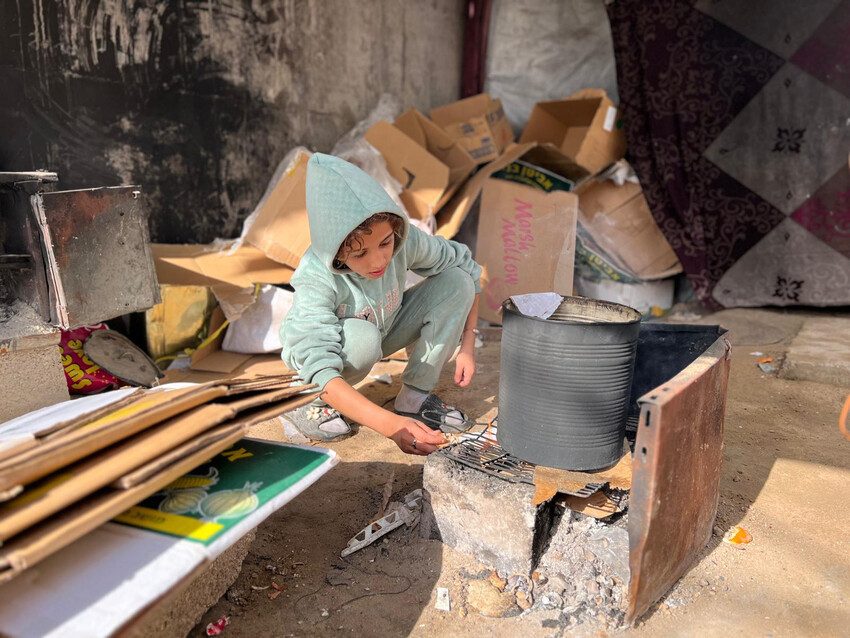
Reality of displacement
The family’s displacement has been long and traumatic. After armed forces ordered the evacuation of their camp, they fled with only few items of clothing each. Some neighbours who tried to return for belongings were killed. Farah’s family moved repeatedly with nowhere safe to stay. When they briefly visited their home, they found it still standing, but returning wasn’t possible.
The conflict has left deep emotional scars. Farah recalls the moment her younger brother was shot while standing near their tent: “A bullet came and hit him. He became paralysed. I will never forget his voice.” She hopes that one day he will get surgery and be able to walk again.
Returning to school
Despite everything, Farah’s determination to learn has not dimmed. After missing fourth and fifth grade entirely, she returned to school just a week ago. “I am in sixth grade. I am happy because I love school and I like to learn. We need schools like the rest of the world.”
“I want to be a teacher, because I love writing and I want children to learn.”
But the school she has returned to has few supplies. “We don’t have anything to read. No notebooks, few pens, and no books.” Still, she has big dreams. “I want to be a teacher, because I love writing and I want children to learn.”
Much needed support
Support from Plan International’s partner, Juzoor for Health and Social Development, has provided some relief. The family has received food vouchers, clothing, medical checks, and physical therapy for Farah’s brother. “We get food, biscuits, and physical therapy for my brother from Juzoor.”
Farah tells us she misses the life she had before, the celebrations during Eid, her home, visiting her grandfather, playing freely with friends. “Now there is no Eid and no one to celebrate with,” she says. “I miss eating sweets and chocolate. I sometimes feel sad when I see something available in the market but I can’t buy it for my siblings because I don’t have any money.”
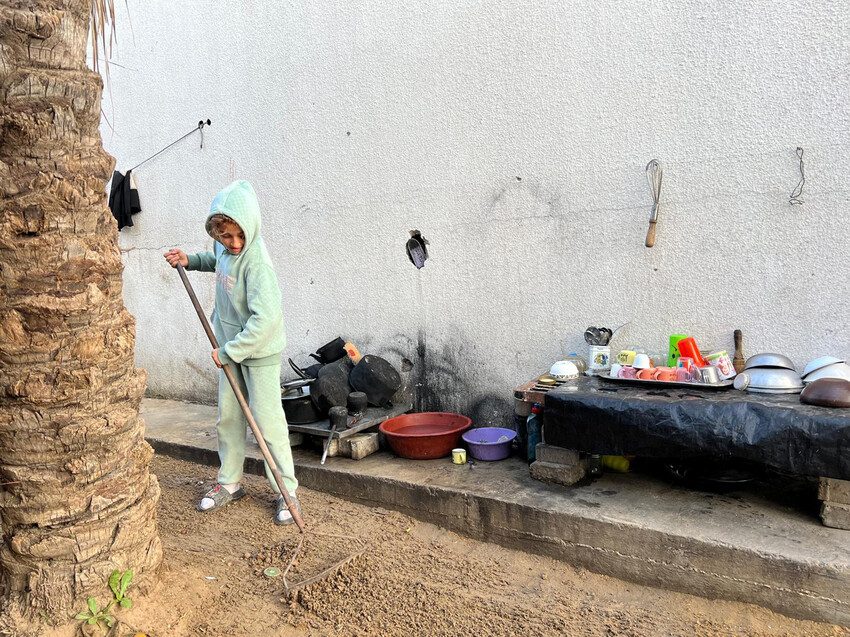
But amid loss and upheaval, moments of childhood still break through. “I feel happy when my friends call me to play,” she says. She and her cousins jump rope, play on a swing, or climb over rubble because there is nowhere else to go. She loves telling children’s stories and writing them in Arabic.
Although Farah’s daily life is marked by struggle, her imagination remains intact. Her hope for a future in a classroom, of teaching, reading and learning, endures.
In a landscape where so much has been lost, her dreams are one of the few things that remain.
Support girls like Farah
Stand with girls, children and families enduring this ongoing humanitarian catastrophe.
Related pages