Our work on climate, disaster and risk preparation and actions
This capacity statement outlines how we integrate technical expertise with gender-sensitive approaches to co-create long lasting solutions with communities. Our work focuses on strengthening agriculture systems, advancing climate action, reducing risk, and helping communities prepare for and ensure timely and effective responses to climate‑induced crises.
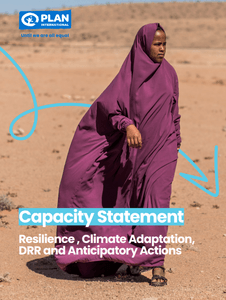
Plan Somalia is a committed humanitarian and development actor operating across climate-vulnerable regions of Somalia. We stand to strengthen community resilience, promote sustainable livelihoods, protect the most vulnerable populations (especially women, youth, and displaced communities), and foster inclusive recovery and long-term development.
Our values and core strengths
Strong local partnerships and contextual understanding
We engage closely with local communities, including displaced populations (IDPs), women-led groups, and youth networks.
We are versed in Somali social, economic, environmental contexts and work collaboratively with government authorities, disaster risk agencies, local civil society, and international humanitarian and development actors.
Community-centered, inclusive and gender-responsive approach
We prioritise the participation of women, youth, and marginalised groups in all our work, from training and enterprise development to financial inclusion and decision-making.
Integrated programming across climate resilience, livelihoods, early action and protection
Our programming model links sustainable livelihoods (agriculture and poultry), disaster risk management, early warning and early action, community-based finance, and child & gender protection enabling a holistic and multi-sectoral response tailored to Somalia’s complex challenges.
Our programmes and capacity to act
1. Resilient Future Project – climate-smart agriculture and livelihood diversification
Under this project, Plan Somalia deploys climate-smart agriculture and livelihood diversification interventions targeting drought-affected and vulnerable populations, especially women and youth
2. Anticipatory humanitarian action and early response in Bakool Region
Given the accelerating impacts of climate change recurrent droughts, erratic rainfall, and other hazards, Plan Somalia mainstreamed anticipatory humanitarian action in the Bakool Region through a locally-led, gender-transformative approach.
3. WAHAFA BUILD ROJECT – Developing an anticipatory action plan to minimise drought impacts on vulnerable communities in Baidoa and Hudur districts, Southwest of Somalia
In Baidoa and Hudur, repeated droughts destroy crops, deplete livestock, and displace families. Traditional aid often arrives too late, worsening food insecurity and child malnutrition. Anticipatory action delivers early, predictable support, protecting livelihoods and prioritising vulnerable groups, especially women and children.
4. Integrated climate resilience, child protection and social systems strengthening
Recognising the strong interlinkages between climate stress, socioeconomic vulnerability, and social norms (e.g., harmful practices), Plan Somalia integrated climate-resilient livelihoods with social protection, gender equality, and child protection interventions.
5. Education and climate change – strengthening safe, resilient and inclusive learning environments
Recognising how climate stress affects learning, safety, and wellbeing, Plan Somalia integrates climate-responsive education with community resilience, early warning awareness, and child protection. Our approach strengthens school systems, supports teachers, and empowers learners and communities to better prepare for and respond to climate risks.
6. Institutional and partnership capacity governance, coordination and sustainability
Plan Somalia possesses robust institutional structures and management systems necessary to deliver the proposed interventions at scale and with quality. Our capacities include
Strong project governance, accountability, financial management, and transparent reporting. Our systems align with accepted NGO standards for programme planning, implementation, monitoring and evaluation. Read more below
Download the capacity statement
Resilience, Climate Adaptation and AA-Capacity Statement
2.00 mb
Categories: Emergencies
Related pages